

It started with design, along the way there was work with universities, and now you run highly regarded online courses. Who are you today and what exactly do you do?
Above all, I want to believe I'm a designer. I mainly design visual identities and websites for brands and institutions. I work as a freelancer, and for specific projects I put together small teams of specialists that I lead. That's how it was with the new Kalstore too. Five years ago I started a romance with online education and found myself really at home in it. Back when I was working with clients as an art director, I felt I could explain complex design problems in an understandable way, so when the opportunity came up, I tried teaching through online courses. And it caught on.
At the same time I know that if I stop designing, I'll stop being a teacher – because I'll have nothing to teach. I really don't want to end up as someone completely detached from the everyday reality of design. That's why I keep working with clients and want to stay in the design process. It creates quite a tension in my life. The education business is profitable, but it takes a lot of time and energy that I don't put into my greatest passion – design.
It sounds like you're very busy. How do you organise it all?
I like to feel that I have things under control. When there are too many projects and responsibilities, everything starts spinning, and I pay for it with my wellbeing. For as long as I can remember, I've been looking for a system to protect me from that. My first adventures with structuring work were with Getting Things Done – a repeatable scheme based on an “inbox” for incoming tasks, which are then assigned to the right projects. The system works, but only if you apply it with exceptional consistency. So if some screw-up happened along the way – and I'm a perfectionist too – and things piled up, it was hard for me to get back to square one. That caused frustration, a bad mood and the feeling that it's either all or nothing. Do you know that feeling? Or is it just me?
I know it, I've been there many times. Did you find a way out?
The older I got, the more I understood that I'm not made of iron and that my mood, motivation and drive fluctuate. I need a system that adapts to my life – one that's resilient to the fact that one day I wake up and work burns me. When my way of working changes, when I change – the system evolves. In the long run, rigid rules only cause guilt and shame. I don't need that in my life.
When I worked only with clients, I needed a very stable system so as not to go crazy. Now that I mainly do educational projects – seasonal, in bursts – I work completely differently. There are periods when I plan a month-long trip: I assign tasks to my team and create procedures so that nothing falls apart. Then I leave, and my duties come down to checking Slack twice a week. That's paradise. But there are also periods when I work 14–16 hours a day for seven weeks.

I've tested many apps, but in the end I went back to combining a simple to-do list app (Things) with an analogue weekly planner. The paper planner gave me something I didn't have on the computer – a human element. That I can take a fineliner and underline something, draw something, add emphasis. It's closer to my heart than a soulless Excel table.
It sounds like you know what you're doing.
Thank you, though I don't think so (laughs). I probably just know myself better than a few years ago. I've done some work in that direction: therapy, books, building habits, bodywork. I've got used to myself, got to know myself and found my comfort in that. Maybe I've even come to like myself a little!
For as long as I can remember, my wellbeing has swung like a sine wave. That's the price I pay for being a sensitive and creative person. There were periods when I had to force myself to do simple things. Back then a rigid system helped – it kept me in check and didn't let me sink. Now, when my boat rocks hard, I don't expect the system to steady it. It's time to accept things as they are, let go and take care of myself. I'm recovering from an obsession with control. I don't know if I have enough life left to cure it completely, but I'm having some success.
There are two wolves within me. One wants to stand to attention at roll call at sunrise. The other prefers to sleep in, eat well and read a book. Both have a say.
So how do you work now?
I start the week with a false start. On Sunday evening I like to sit down for a couple of hours and check what's ahead. I try to avoid the shock of switching on my computer on Monday after two days off and feeling a wave of things to do flood over me. I'd rather know the day before what the priority is and what order to take. I also check what's still “hanging” from previous days and plan the week on that basis.
Three days a week I start with training, so I sit down to work around 11:00–12:00. Instead of forcing myself to work from the morning, I prefer to exercise, have a coffee, eat a good breakfast and start later. I've been doing this for two years and the world hasn't collapsed (I'm shocked).
I also give myself a dispensation to be distracted. I humbly wait for focus to come. Often, even halfway through the day, my brain is still all over the place, and then suddenly the laser focus switches on. I love that state.


And how do you remember working on the website and the new image of Kalstore?
Stanisław from Kalstore came to me at the last minute with a project that fell during my holiday. I would have turned down any other project in that situation, but I wanted to work with Stanisław, so I agreed on the condition that, once the foundations of the system were in place, I would manage the team remotely for a month from various places in Europe. Looking back, I question that decision. It was made by the strict, hard-working wolf. When I work and rest at the same time, I don't do either of them well. Anyway – it's great to have this project in my portfolio, and it was great to get to know Stanisław through the process. So thanks, strict wolf, you're alright too.
When you look at your work, do you allow yourself to be proud?
Not day to day (laughs). Those are short moments. The last one was watching my work projected onto the front wall of the Museum of Modern Art in central Warsaw. The museum's opening, the biggest cultural event in the capital in years. A thousand people queuing to get in, and above their heads my animation the size of a tennis court flying by. That was my last short “I made it” moment.
Luckily, I have people close to me who stop me and tell me to look at what I've achieved and be proud of it. I obediently follow the order.
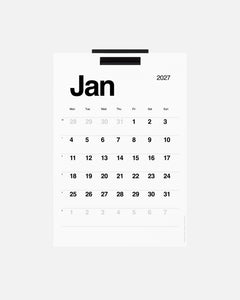
Wall
Wall calendar- White

And when you have looser or even free time, how do you cope with it? I imagine for someone like you it can be quite a stressful experience.
Resting really is a big skill, one I'm slowly learning. My soul only rests when I travel. When I break away somewhere straight from work, for the first few days I feel like I'm neglecting my duties: here I am on holiday, but I can't relax.
You're in the antechamber.
And I'm boiling inside! (laughs) What's wrong with me? I'm finally in a beautiful place, and yet I feel tense. Only after 5–6 days does the first wave of tension let go and I start enjoying where I am. I breathe more deeply. I stop picking at the skin around my nails. After another ten days I really start to feel the sand under my feet.
It's one thing to plan a restorative trip, and another to find time to rest when you're up to your neck in work.
Oh, totally! All the harder because I do everything to be up to my neck in work 24/7! In demanding periods I simply work hard and try to find relief in down-to-earth things. I let my partner drag me out for walks. I escape into making music as an amateur – thanks to that I can disappear into another world for two or three hours a day. For me it's an almost meditative way of spending time. In difficult periods I also try hard to keep weekends free, or at least Sundays.
And what do you do then? Sleep, read, watch something, or just lounge around?
I'd like to say I read and watch documentaries, but most often I lie on the bed and feel like being a stone. If I get myself to read a book, I never regret it. But when I'm really tired, it's hard to offer my brain ambitious rest, because there's no room left for it.
That sounds like the purest regeneration in the world.
Partial, patched together – yes. Full regeneration in a busy period is impossible. To rest fully, I need a sense of having closed something. Then I'm very happy to go away: camping, to the mountains, to the water, sailing. Once a year I go for a week of diving and a week camping in Sweden, fishing. It's a great way to switch off – a complete change of surroundings overnight.

Do you ever take time off in the middle of the week?
Very rarely. And if I do, I feel guilty.
Where does that guilt come from?
That's probably a topic for therapy (laughs). I demand a lot of myself. The strict wolf claims that if I let go of routines and patterns, everything will crumble to dust and I'll never pull myself together again. Wolf, let me live!
The wolf needs to be hugged and looked after. Fighting it is pointless. I don't want to fight myself.
And for dessert: what are your favourite work rituals?
I always start the day with coffee: a flat white, and on hot days an espresso tonic. Plus headphones with music, which give me the feeling that it's just me and the work. At the same time I signal to everyone around me to keep their distance.
For health reasons I'm trying to swap headphones for a speaker, but unfortunately taking care of your health is terribly boring.